“The world begins to crumble when people are quiet about things that matter.”
-Martin Luther King Jr
Despite a sudden upsurgence on the topic of Gukurahundi from twitter platforms to local and international media outlets, the fact remains that this has been a topic that has been swept under the rug and not muttered in any voice higher than a whisper at least for my just over two decades of existence. And to date, Gukurahundi remains a very sensitive and emotive topic that demands to be adequately addressed, as has been the lament of many.
If you clicked the link to this blog post under the impression that I, Terry-Nesu, would be the one to address the topic, then may I advise you to stop reading at this very juncture as that is neither my intention nor the purpose of this blog as that’s far beyond my capabilities to do justice to.
Now that I’ve clearly stated what this blog is not, allow me to briefly state what it is. Having come to the realisation that this pertinent topic is something I don’t recall ever being mentioned in school history lessons, I realised that there was an abyss between what I knew of my beloved Zimbabwe’s history, and what actually transpired between 1980 (Independence) and now. My passion and interest for all things Zimbabwean meant that upon hearing that there’d be an open dialogue forum addressing this issue, I’d be one of the first through the doors to gain a better or broader understanding of what I like to describe as, the elephant in the country.
This blog therefore seeks to share the outcomes of that dialogue, something that many indicated a keen interest to attend and learn from, but for one reason or another could not.
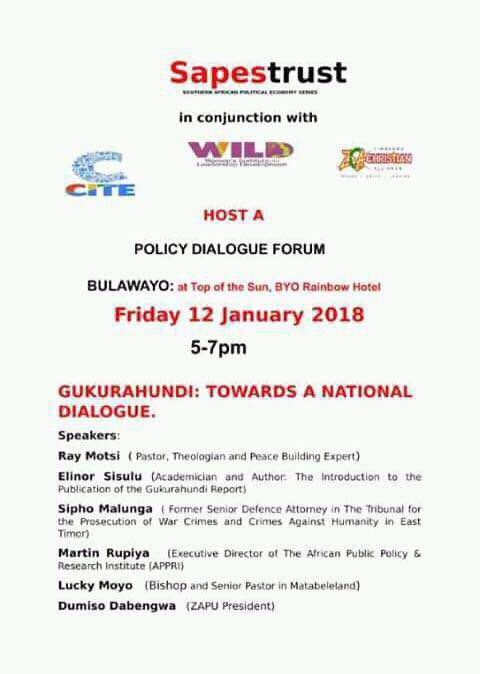
The flier above succinctly gives a brief background of the panelists, as well as the parties that made the dialogue possible. That said, I’ll go on to summarise what I captured to be the key points from the panelists as well as some of the questions/comments from the audience.
The dialogue began with Pastor Motsi stating categorically that Gukurahundi was a national disaster that needs to be declared as such and that if it’s recognised internationally, we shouldn’t be hesitant to give it the recognition it deserves either. He stressed the fact that we could not move backwards looking forwards, emphasising how the terms Shona and Ndebele are political constructs that limit what we can do. According to him, the purpose of the national dialogue should allow people to speak truth about themselves, who they are, and where they’re coming from without restriction. He went on to describe how Gukurahundi was perpetrated by government using government machinery, and that the government must acknowledge this! An interesting analogy he used was that the idea of letting sleeping dogs lie is a dangerous one as those sleeping dogs wake up and bite people again. His closing remarks were in my opinion very wise as he said,
“National dialogue allows for a national buy in which allows for a collective recollection of the past and brings a common base on which to hang our future.”
Next up was Sipho Malunga whose presentation hit so many points dead on! He began uttering that many people, EXCEPT THE VICTIM, have spoken about Gukurahundi! The victim is never asked how they feel, and perpetrators retain control over everything affecting the victim he continued. He paid particular emphasis to the importance of removing obstacles that disallow people from speaking out, and described how the brain parks trauma away so it doesn’t come back, but that the pain always does come back, only as post-traumatic disorder, a condition that needs no explanation. Some practical steps suggested by Sipho included counseling and psychological aid to support the people who experienced these traumatic experiences. In conclusion, as the country focuses on development, he alluded to the fact that nothing happened in Matabeleland for the longest time, which caused an imbalance in the development of the region. He therefore insisted that any program or policy have a plan to empower the Matabele people in general, and the victims of Gukurahundi in particular.
In a way, we are all victims, though it’s true that some were affected by Gukurahundi more than others, began Elinor Sisulu as she quoted a popular trade unionist who said, “an injury to one is an injury to all.” Mrs. Sisulu went on for a prolonged period of time acknowledging the various individuals and platforms that gave her a voice such as the women of WOZA. She ended by emphasising how we had to open the silence and talk about it. She said, “ I don’t think there’s been an enough of a recognition and campaign for the importance of media freedom in Zimbabwe…
People fought for the constitution, but it doesn’t matter if there’s no constitutionalism!”
Martin Rupiya, after contrasting the level of dialogue on pertinent issues to countries like Togo and Ethiopia, argued that nobody appears to want to say, “ We made a mistake, let’s sit down and discuss this matter further”. He went on to further cement many people’s suspicions by saying that we think we know what happened, but we need a research team to better drill down into the issue. He urged people that we must learn to not respond with default responses if we’re to forge a new Zimbabwe, and that it was pivotal to create an undivided community.
With a significantly longer presentation was the final panelist, Dr. Dumiso Dabengwa who is the leader of the Zimbabwe African People’s Union party (ZAPU). Noteworthy from Dr. Dabengwa’s was the number of nodding heads he got after virtually every sentence. His account described how he was of the opinion that Gukurahundi had been planned from as early as the Lancaster house talks. The reason being, he recalled an instance where the former president R.G Mugabe had said that all neighbouring countries weren’t threats, though the same wasn’t to be said about ZAPU and ZIPRA. A statement that Dr. Dabengwa said he was revealing for the very first time!
Dr. Dabengwa went on to state unequivocally that, “We will not speak, we refuse to speak, until an acknowledgement and an apology has been made! Gukurahundi was genocide, and no doubt about that.”
Q & A session
A number of questions and comments were raised thereafter which were mostly focused on :
• the fact that people wanted more assurance that this dialogue wasn’t just a show as elections approach.
• that they’d have wanted to see activists being braver, as well as more definitive figures of approximated deaths being released.
A comment that received great support from the majority of the audience was by an old man who said, -(translated from Ndebele) – “The dialogue started long ago! It didn’t start today or yesterday because you’ve now been financed to talk about it. You were all quiet until now. You’re preaching to the choir, preach to those from the north who have cotton wool in their ears. Dr. Dabengwa, don’t keep quiet, you know these things! Today you spoke, you became a man!”
In conclusion, it was a very civil dialogue, save for the brief period when a lady who was suspected to have been a Central Intelligence Officer (CIO) raised a question on the legitimacy of one of the panelists, which inevitably infuriated the audience and led to the lady being escorted towards the exit. Regardless, in contrast to the Harare dialogue which had occurred a day earlier, the Bulawayo dialogue was described by the panelists as having gone on fairly smoothly.
With regards to the topic at hand, as expected, there was no miraculous quick fix solution, but the topic was back out in the open which will hopefully lead to its being adequately addressed sooner.
From my perspective, or my 2 bond coins as I like to describe it, I was disappointed that a lot of the panelists shaped their comments and perspectives on assumed knowledge which as aforementioned, is something that’s frankly not a reality. Gukurahundi is a very grey area topic that is in dire need of more literature that’s true to reality to become accessible to the general public, lest more and more people squabble in speculation.
If you read this far, kudos to you, and I’d love to hear what your opinion on the matter is either in the comments or privately.
“Reconciliation or conciliation requires defrauded parties to be made whole, not just apologizing for the offence.” -Facts, Lecrae
Until next time.
All good wishes,
Terry-Nesu
*This article first appeared on my my blog on 20 February 2018.
 Terry-Nesu